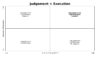
Quality of Judgement and Intensity of Execution

ahmedUncategorized3 Comments

The more I play in the sport of business, the more I realize that these 2 variables make all the difference on who wins and who doesn’t.

Quality of Judgement: clarity of thought, sharp decision making, raw intelligence
Intensity of Execution: relentless action, getting things done, raw hustle

I’ve met people who have one of the 2. They’re almost worse than those who have neither, because they deceive you into thinking they’re somewhat good, and you keep playing with them for too long in hopes of them fixing the other element.

Someone with high Quality of Judgement but low Intensity of Execution is a philosopher. You enjoy talking to them for hours. Every time you catch up with them, you remember how smart they are, and leave wanting to give them another chance. But they fail you again and again, because they’re not putting in the work to action their beautiful ideas. They almost feel like “execution” is dirty work that prevents them from doing more thinking.

On the other hand, someone with high Intensity of Execution but low Quality of Judgement shut you up with their relentless work ethic. They make you feel like you don’t work hard enough. They hustle so hard nobody dares question them. They’re like a martyr of the business; sacrificing sleep and health in the pursuit of more execution. You’re in awe seeing them work, but every time the results come in, you realize that they’re not rowing in the right direction. They’re so busy working that they don’t have time to think.

Neither of these are winners. It all goes back to the concept of the “Tension of Opposites”. You need a bit of both. Sometimes you need more thinking than action, but once you find something worth actioning, you must shift gears into more action than thinking.

Rare are those who can balance both. The wise ones would figure out what they’re stronger at, and complement their weaknesses with people on their team who are stronger at what they lack or don’t enjoy.

If you’re hiring a leader, make sure they have both. Much easier said than done.

The Most Scarce Resource

ahmedUncategorized1 Comment

Intelligence was thought to be the most scarce resource to lead to success.

Today, that’s changing, and I want to make an argument that another resource overtakes that title.

Intelligence is being “democratized”. Everyone has access to it today.

What is intelligence?

I think it’s simply the ability to make good decisions (learn, analyze, and pick the best option).

For the first time in human history, we can outsource intelligence to a machine.

While we were able to do so for years when it comes to mathematical and computational problems, it’s the first time we’re able to simply “talk” about our non-computational problems and get suggested answers and decisions.

Today, I can tell a large language model about the situation I’m in and get instant advice on what to do to achieve a goal I desire.

What remains is:

  1. How badly do I want it? (ambition/hunger)
  2. Will I actually get it done? (discipline)
  3. Do I really want it / is it worth pursuing? (wisdom)

I think wisdom comes as a result of doing many things (experience) which then makes it a function of discipline (doing things). So let’s park that on the side for a bit.

Discipline itself is the ability to do hard things even when one doesn’t want to (grit, put in the work, etc.)

Discipline becomes easy when someone wants something badly enough or when their back is against the wall and they have to perform (i.e. ambition/hunger).

Therefore, I think everything is the function of ambition/hunger.

That’s the resource in short supply today.

I’ve had this belief for some time now:

You can do anything you want to do if you want it badly. If you don’t do it, then you don’t want it badly enough.

This is more and more true today.

If you want it badly enough (ambition, desire, need) then you will be disciplined enough to do what it takes (learn, work, sacrifice).

And today, you need a much smaller “intelligence” component to figure it out (critical thinking, analysis, etc)

I’m not saying that these things will stop being important – on the contrary! I think whoever has them (on top of ambition/hunger) will outperform as always, but the barrier to entry of today’s conventional definition of “success” (e.g. build a successful “tech” company) will vanish, and everyone will be able to do it without the intelligence they would’ve needed 5-10 years ago.

I can go through a rabbit hole on what makes people “hungry” or ambitious, but maybe another day… it’s another topic of interest of mine.

Chip on the shoulder? Napoleon syndrome? Middle child? Migrant chip? The list goes on…

Someone should study this and classify chips on the shoulder into archetypes similar to Jungian archetypes.

Quick tip to walk away with: IMO a fun way to do life is: hunger/ambition ⇒ discipline ⇒ financial freedom ⇒ fun & learning ⇒ wisdom

Questions that are unanswered for me:

  • how do you birth hunger/ambition?
  • should you birth hunger/ambition? < wisdom
  • how can you spot talent with hunger/ambition before anyone else does? (investment, recruitment)

Stay hungry ✊🏻 (or don’t ✌🏻)

Why Not Tomorrow?

ahmedUncategorizedLeave a Comment

Another billion dollar question that I love is: why not tomorrow?

Acting with urgency is a super underrated trait.

If you’re leaning towards a decision, but still feel unsure, ask yourself: why not tomorrow?

List down the reasons. If those were to be resolved, then you should be doing it tomorrow, right?

Okay, then turn every reason listed into a task.

Then answer this: how long would it take to figure it out? For each reason/task.

Now you have:

  1. Your answer to why not tomorrow
  2. Your list of tasks to work on
  3. Your closest estimated timeline instead of “tomorrow”

If you’re intentional about making it happen, then do it fast.

Anything worth doing, is worth doing fast.

Speed and urgency are not excuses for not doing something well.

You can still ensure you’re doing something well, but with urgency.

Perfectionism often creeps in. Doubts and fears also slow us down.

So if you equip yourself with the weapon of urgency..

If you don’t take “tomorrow” for granted..

If you don’t assume you’re going to live a thousand years..

then you would get more things done, and live more lives in one lifetime.

Another way to put this is something I’ve heard from Peter Theil: “What are your 10 year goals? How can you do them in 6 months?”

So, why not tomorrow?

What are you optimizing for?

ahmedUncategorizedLeave a Comment

I fell in love with this question a couple of years ago.

Whenever someone tells me “I want to start a business.”

I ask: “what are you optimizing for?”

If you’re optimizing for making $10k a month in passive income without having to work much, you’d need an entirely different plan than someone who’s optimizing for making $10m in 5 years regardless of how much effort it takes.

The thing is, nobody asks themselves that question when they’re starting out.

Whenever we take action, there’s an inherent goal tied to it. We just don’t always think about the goal itself.

Sometimes the answer is not so pretty.

“I want to buy a nice car”

“What are you optimizing for?”

“Signaling higher social status to my community”

Nobody wants to admit that! But it’s often very true.

Whenever I find myself about to take an action or make a decision today, I ask myself this question. It did wonders for me.

Also, it’s a common mistake to be optimizing for 10 things at the same time. Everyone wants to be super healthy, wealthy, happy, and have a killer social life, travel the world, but also settle down and have a nice home, etc…

It’s impossible to succeed at optimizing for 10 things at the same time. Pick the goal you care the most about now, and expect to not make as much progress on the other 9. Once you achieve 1, optimize for the next most important one.

What are you optimizing for in the next 5 years? (what life do you want to live?)

What are you optimizing for this year? (Health goal? Financial goal? Fun goal?)

What are you optimizing for today? (What tasks do you want to achieve?)

Try to ask yourself this question every day, see what it does for you.

Bite More Than You Can Chew

ahmedUncategorized1 Comment

Conventional wisdom is great to follow, if you want to be average.

The great thing about working at a startup is that you’d be given responsibilities you’re unqualified for, and asked to figure it out.

That discomfort causes you panic, anxiety, stress, etc. But it also is what creates growth.

The feeling of soreness a day or two after a killer workout is the physical equivalent.

Growth does not happen without tear. You must tear your muscles (have them handle more than they could) in order for them to grow in the recovery process.

In a world that’s more extreme than ever, being extremely good at something has never been more valued.

Read More

Business Problems vs. Founder Problems

ahmedUncategorized11 Comments

Recently, I started advising a few early stage founders and investing in a couple.

I realized today after one of those sessions that there are 2 types of problems in early stage startups: business problems, and founder problems.

I wrote down a few notes to discuss problems I saw with the founder’s execution: marketing, product, and hiring.

I was unhappy with their execution, and I felt that something was off.

For some reason, I got the inspiration to ask: are you okay? Is everything fine on your end? Before pestering them with specific feedback on their execution. That unpacked a lot, and we didn’t need to discuss the business problems.

My initial impression of this founder was very positive. High agency, gets things done, hungry, etc. However, my impression was changing as a response to poor execution in the past couple of months.

I told him “there are 2 types of problems: business problems, and founder problems”. Business problems are easy – you can resolve all of them. I can help you with those.

However, I can’t help much with founder problems.

What are founder problems?

Read More

No Plan

ahmedUncategorized2 Comments

“The Plan is No Plan”. This statement was repeated about 100 times in 2 weeks of camping away from civilization with a group of friends.

“What’s the plan tomorrow?” => “the plan is no plan”
“Are we going to this mountain?” => “the plan is no plan”

We were living each day at a time. There were ideas from the days prior, but we chose what we wanted to do on the day itself. The default was dropping any idea or commitment from the days before, and starting with a blank slate: what feels right today?

Read More

Engine vs. Body

ahmedUncategorized1 Comment

In the movie “Ford vs. Ferrari”, the driver of the Ford GT was advised not to push the RPM too hard, because the physical body of the car couldn’t handle how powerful the engine was.

Sometimes, it feels like that’s what I’m consistently doing; pushing mental RPM to the max, and in the process putting a lot of strain on my physical body.

Read More

Business is a Sport

ahmedUncategorized2 Comments

This analogy changed the game for me. This is a brain dump of the analogy broken down into a few areas.

  • Business is a sport
    • Most people think of sports as “physical”. Business is a mental sport
    • Business is a team sport, you can’t play on your own
    • Basketball is about getting the ball in the enemy’s hoop. Business is about solving customer problems
      • The bigger the problems you solve, the more customers are willing to pay you for it
      • The more people that have such problem, the more customers you would have
  • Score
    • The score in basketball is a count of how many times you got the ball through the hoop. The score in business is about how many times you solved a customer problem
    • The score is revenues and profits, exchanging your “solution” with the customer’s money
    • People pay you their hard earned money if you’re truly solving a big problem for them
    • The more uniquely you’re solving it, the higher people would be willing to pay your for it (high margin). The less differentiated your solution is from others, the less people would be willing to pay you for it (low margin commodity)
  • Athletes
    • The best sports teams comprise of the best athletes and supporting teams (coaches, trainers, etc.)
    • Employees are athletes of business. Depending on the league, your business might have superstars, or laid back amateurs
    • The best athletes want to win badly, and do whatever it takes to do so
    • The best players play because they’re obsessed & in love with the game. Money is just the score; it’s not why they play. But it indicates winning, and they care about winning
  • Positions
    • In football, there’s attack, defense, midfield, etc. In business, there’s marketing, operations, finance, etc
    • Each position in business comprises of a team. If you want your finance position to be world-class, you must have a world class leader and players under that leader
  • Performance
    • You can measure the performance of a defender in basketball by how many shots they blocked. 9/10 is a good defender, probably
    • In the sport of business, there must be some measurement of performance as well for the athletes (aka KPIs; key performance indicators or OKRs; objectives & key results)
  • Leagues
    • Every sport has its leagues. You can play in a semi-professional 5th league, or you can play in the Premier League or the NBA
    • Business also has leagues. League 1 has the biggest companies in the world (Apple, Nike, Porsche, etc)
    • At the bottom of the list, you have small businesses that are operator owned offering commoditized products & services
  • Winners & Losers
    • The 2nd winner is the 1st loser; applies in sports and business equally
    • The sport of business has infinite divisions/sub-sports (industries/markets). If you’re selling sports shoes, you’re in competition with Nike. They are the winner, you are the underdog (for now, at least)
  • Competition
    • How badly you want to win dictate how much you win
    • Business is the most competitive sport in the world. While you sleep, someone out there is trying to outcompete you
    • In physical sports, there are seasons, game times, and schedules. In business, it’s 24/7, all year long. It never stops
  • Rules
    • In physical sports, there are associations that define the rules of the game. In business, there are no rules
    • The closest thing to rules are regulations that governments set up, but those often define the rules to play fairly, not the rules to win
  • Olympics
    • Startups are the Olympics of business
    • Founders of startups embody elite athleticism that sets them apart. They find out what the ‘world record’ is, and take on whatever Goliath that came before them
  • Team Spirit
    • Is everyone showing up on time for practice? Is everyone putting their 110%? If not, morale takes a hit, and team culture/spirit is hindered
    • Company culture is the equivalent for team spirit in sports
  • Coach
    • In physical sports, the coach and supporting team are instrumental to winning. They have the birds eye view, and work with the players to improve their game
  • Team of Teams
    • In basketball, you have 5 players. In football, you have 11 players. In business, you can have a million players (divided into smaller teams)
    • Unlike physical sports, business can have nested teams. The “defender” actually has a team of 5 defenders. Each of them has a team of 5 more defenders. Sometimes, each of those also has 5 more defenders. Each of them specialize in a specific type of defense

I’ll keep updating this every now and then.

If You’re So Smart…

ahmedUncategorizedLeave a Comment

If you’re so smart, how come you haven’t figured out how to be happy?

I heard something like this a while ago and it stuck with me.

I started using it as a mental model to play tricks on my mind.

If you’re so smart, how come you aren’t fit yet?

If you’re so smart, how come you haven’t achieved financial freedom? The list goes on…

Our ego tells us that we’re the smartest person in the world.

It creates all these narratives about how you’re the best and how everyone around you just doesn’t get it. It fools us into comfort.

But if you face reality and ask such questions, you realize that there’s a lot for you to do to prove that you’re so smart.

And you get to use this perception or belief that’s generated by your ego (that you’re so smart) to fuel work to making such goals happen.

If you are so smart, then achieve happiness, become fit, and gain financial freedom in the next couple of years.

Otherwise, are you so smart?